RIPPCSX2 is a PlayStation 2 emulator built for testing. It is PCSX2 v2.9.96 with what a PS2 homebrew developer needs to see the real thing, made to be driven by you or by an AI agent.
It began as the test lab of the RIPPS2 front end. It is for anyone building PS2 homebrew, themes, tools or game fixes.
Windows 10 or 11, or Linux as an AppImage: x64, a CPU with AVX2. Unzip it anywhere and point it at your own BIOS dump. It keeps its settings in its own folder, so a PCSX2 you already have is not touched.
What it adds to PCSX2
- A RIPPCSX2 menu with all of the below in one place, built like the menus beside it.
- The EE's data write breakpoint. COP0
BPC, DAB and DABM work, in the interpreter and the recompiler. OPL's GSM and in-game menus depend on it.
- True 720p and 1080i. Shown 16:9, captured at 1280 x 720 and 1920 x 1080, screenshots the same. Stock PCSX2 draws them 4:3.
- 1080i in the right place. From line 40, as the console's own timing has it. Stock moves it up 42 lines.
- Recordings that survive a mode change, carrying on in a new file at the new size.
- Video mode lines in the log, with the sync timing and each display's registers, on every change.
- RIPART. OPL Manager's art database in the menu: decoy game entries for themers, every game's art to choose from, and art for the games on a drive.
- Stock OPL's IOP reboot. A
host device a program registers itself now gets its own opens, so unmodified OPL starts a game. In stock PCSX2 it stops at file 'host0:' can't open.
- EXIT GAME reaches the browser. A SIO2 interrupt was lost over an IOP reboot, which left OSDSYS waiting on the memory card with a black screen.
- A taskbar button for hidden runs, so a volume mixer or a per-app volume mod reaches a test run like any other program.
Everything else is plain PCSX2, and standard definition is byte for byte the same as stock. Each change can be turned off for a side by side.
BIOS and storage: where it is strong
RIPPCSX2 runs your own BIOS dump, so the region, the ROM version and every step from power on are the real ones. This is what has been run here, and what has not.
- Fat consoles
- Shipped with ROM 1.10 to 1.90 (SCPH-30001 to 50001 in the US). ROM 1.60 (SCPH-39001) is the one most tested here: RIPPS2, stock OPL, games, and EXIT GAME back to the browser.
- Slim consoles
- Shipped with ROM 2.00 to 2.30 (SCPH-70001 to 90001). ROM 2.20 (SCPH-77001) boots to the console's menu and memory card browser and runs the boot paths tested here. ROM 2.30 has not been tested yet.
- A virtual internal hard drive, exFAT. The strongest path: RIPPS2, stock OPL and Neutrino all start games from it.
- Memory cards as files. Read, written, compared and swapped between runs, up to the console's real card browser.
- Disc images, in the virtual drive, read like the disc they came from.
- An ELF's own folder, through
host:, while a program that brings its own host device keeps it.
- PS1 games through Ember, on the same virtual drive.
- Neutrino, at full speed. Burnout 3 and Ratchet & Clank reach their attract demos through RIPPS2, and Katamari Damacy its first prompt.
- POPStarter, in part. POPS relies on TLB miss exceptions the EE recompiler only logs, so it stays on a black screen. With the recompiler off it runs at about half speed with damaged graphics: Klonoa reaches a 3D demo with scrambled textures. Good for testing launches, not for playing yet.
Not there yet: USB drives, MMCE and SMB have not been run here, and neither has an APA hard drive. MX4SIO and i.LINK stop a run, so turn them off for now.
What it is for
- Testing ELFs and homebrew
- Run ELF and Run Last ELF: rebuild, press, look. Read the EE and IOP console, the display registers, and PS2 memory over PINE. Keep a save state of the moment it breaks.
- Front ends and tools
- What RIPPS2 is built on: storage, memory cards, video modes, handing over to a game or another ELF, all without touching a console until it is ready for one.
- Theme capture in HD
- Judge a theme for OPL, RiptOPL or RIPPS2 at 720p and 1080i as a TV shows it. Screenshots and recordings come out at the real 1280 x 720 and 1920 x 1080, and a recording carries on in a new file when the mode changes.
- A library for your theme
- RIPART spoofs games: it adds decoy entries with OPL Manager's art, a dozen random full sets by default, on the drive you pick, so a theme can be judged on a real list with no games there. Each decoy is a 2 KB entry for art only and does not start.
- Art for your own games
- RIPART lists all 16,313 games in OPL Manager's database, finds the games on a drive with no cover, and fetches only the pieces you tick. akilluminati47 helped bring that database its 8-bit PNG art and its 128 x 128 disc icons.
- PS1 games
- Run Ember and its PS1 games from a virtual drive to test launching and PS1 lists. Digimon World's intro runs here through RIPPS2 and Ember, with your own PS1 BIOS on the drive.
- In-game menus and GS tools
- Anything built on the data write breakpoint runs here instead of only on hardware: GSM, in-game menus, screenshots read back from GS memory.
- AI-assisted testing
- Scripted runs with screenshots, captures, save states and memory reads, on a hidden desktop that never takes over your PC.
The goal: the whole library
The biggest job for RIPPCSX2 is one nobody has finished: testing PS2 games through Open PS2 Loader's own code path, and writing down what each one needs.
OPL does not run a game the way a disc does. It patches the kernel, swaps the IOP's drivers and answers for the drive, and some games need one of its compatibility modes to survive that. Finding out which takes a console, a copy of the game and an evening, for one title. The aim is that a person or an agent can do it in the emulator, in minutes, then check the answer on a console.
Works today
- Stock OPL, unmodified, starting a game from a virtual drive through its own IOP reboot
- RIPPS2's OPL-derived core starting games from a virtual hard drive, as it does on a console
- In-game menus over real game frames
- ELFs and homebrew, including one starting another
- The Compatibility Report: one game's result, the modes used and the machine's state, saved as a file and a row in a CSV
Where it is going
- The OPL sandbox: stock OPL and its forks across the library, not one game at a time
- Mode patching: trying Modes 1 to 8 on a game automatically, and finding the set it needs
- KELFs, and homebrew apps launched through the same paths they take on hardware
- A shared list: every game, its result, its modes and its fixes
OPL's compatibility modes
| 1 | Accurate Reads: disc reads at the disc's own timing |
|---|
| 2 | Synchronous Mode: reads block until they finish |
|---|
| 3 | Unhook Syscalls: OPL's hooks come back out of the kernel |
|---|
| 4 | Skip Videos: zero-size PSS videos and skipped Bink ones, past a video that hangs |
|---|
| 5 | Emulate DVD-DL: answers as a dual layer disc |
|---|
| 6 | Disable IGR: no in-game reset or menu, for games that clash with the hook |
|---|
| 7 | Neutrino only: fixes a game's buffer overrun |
|---|
| 8 | Slow Reads: Accurate Reads at the CD rate, for audio that breaks under Mode 1 |
|---|
Someone could use this to make the entire library run one day. That is the end goal, and it is why this exists as a fork and not a patch.
Hand it to your AI assistant
The repo is written for agents as much as people. Give yours the link and ask it to set RIPPCSX2 up: the README tells it where to get the build, where your BIOS goes (your own dump, never a download), how to run an ELF or an image from the command line, where the logs and captures land, and how to read PS2 memory over PINE.
https://gitlab.com/akilluminati247/RIPPCSX2
This page
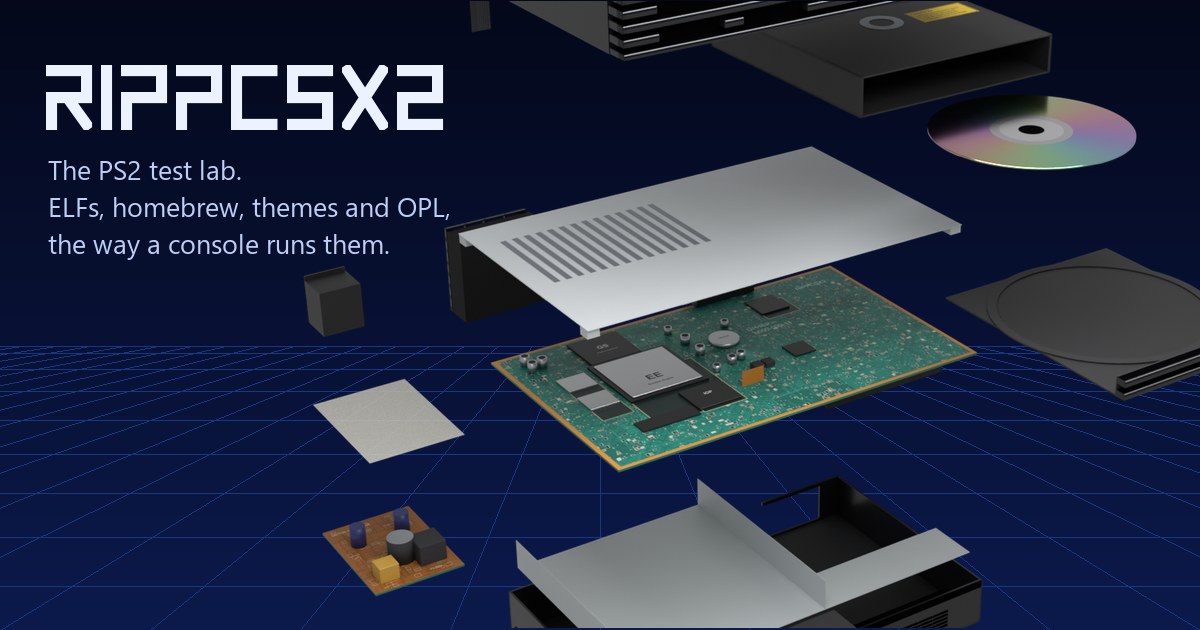
Both consoles are modelled in Blender from published sizes and from photographs, every position measured through a solved camera. The parts inside follow real teardowns. Blow one up and you get the other. There is no Sony audio here: the explosions are synthesised, and nothing loads from any other server. The scripts that build the models are in tools/site/blender.
Unofficial. RIPPCSX2 is a GPL-3.0 fork of PCSX2 by the PCSX2 team, not affiliated with them or with Sony. Please report problems to RIPPS2, never to the PCSX2 project. Sony, PlayStation, PS2, DVD and MagicGate are trademarks of their owners. Made by akilluminati47, built with Claude.